Physicians for Informed Consent Publishes Comprehensive Analysis of U.S. COVID-19 Infection-Fatality Rate by Age Group

NEWPORT BEACH, CALIF. (PRWEB) AUGUST 24, 2021

New data indicate about 180 million Americans already infected and have 99.9% protection from repeat infection

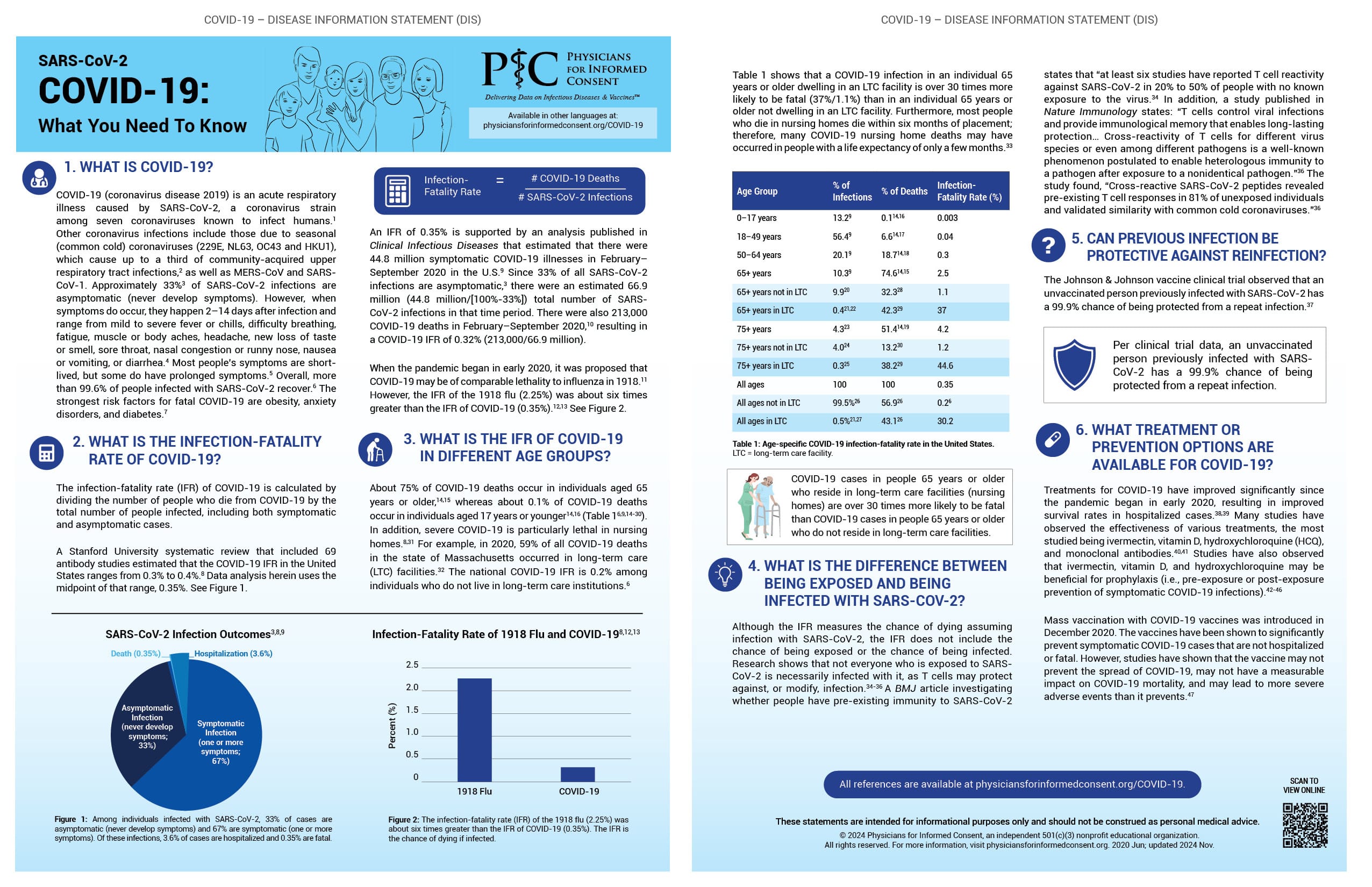
Physicians for Informed Consent (PIC), an educational nonprofit organization focused on science and statistics, has published its updated COVID-19 Disease Information Statement (DIS), which elucidates the infection-fatality rate (IFR) of COVID-19 in different age groups and different locations of residence.

Overall, the risk of a fatal outcome from COVID-19 is 0.35%. However, the risk varies from 0.001% or one fatal outcome in 100,000 infections in children younger than 18 years to people 65 years or older living in a nursing home having about 30 times more risk of a fatal outcome than people 65 years or older not living in a nursing home. Additionally, overall, the risk of hospitalization is 3.6%, of having symptoms is 67% and of never developing symptoms of SARS-CoV-2 infection is 33%.

The calculation for determining how many Americans have already been infected with SARS-CoV-2 is explained and indicates that more than half of the U.S. population has already been infected and is 99.9% protected from reinfection. As vaccine breakthrough infections are now on the rise, important lesser-known treatment and prevention options are also discussed.

“Now one can better compare a person’s risk of COVID-19 versus the risk of a severe side effect from a COVID-19 vaccine,” said Dr. Shira Miller, PIC’s founder and president. “It’s clear there’s a rational and scientific basis for those who choose to decline COVID-19 vaccination, especially in certain age groups.”

Physicians for Informed Consent’s body of physicians, scientists, statisticians, and healthcare workers is trusted by both patients and practitioners for providing scientific data on infectious diseases and vaccines. To learn more, read PIC’s two-page handout here: physiciansforinformedconsent.org/COVID-19.

About Physicians for Informed Consent
Physicians for Informed Consent is a 501(c)(3) educational nonprofit organization focused on science and statistics. PIC delivers data on infectious diseases and vaccines, and unites doctors, scientists, healthcare professionals, attorneys, and families who support voluntary vaccination. In addition, the PIC Coalition for Informed Consent consists of approximately 300 U.S. and international organizations. To learn more or to become a member, please visit physiciansforinformedconsent.org.

###

VIEW the press release on PRWeb.
SHARE the press release on Facebook.
SHARE the press release on Instagram.
SHARE the press release on Twitter.
SHARE the press release on LinkedIn.

Physicians for Informed Consent Submits Amicus Brief to U.S. Supreme Court in Pivotal Vaccine Mandates Case

NEWPORT BEACH, CALIF. (PRWEB) AUGUST 11, 2021

Amicus presents scientific evidence supporting plaintiff college students declining COVID-19 vaccination at Indiana University.

Physicians for Informed Consent (PIC), an educational nonprofit organization focused on science and statistics, filed an amicus brief in support of plaintiff college students who are declining COVID-19 vaccination at Indiana University (i.e., the case of Ryan Klaassen, et al. v. Trustees of Indiana University).

Indiana University recently mandated COVID-19 vaccination for college students. While the college does offer a religious exemption, the college is still requiring unvaccinated students to wear masks and engage in frequent SARS-CoV-2 testing, even if the student proves natural immunity. The plaintiff students brought suit in Federal Court in Indiana (1:21-CV-238 DRL) requesting an emergency injunction because they claim the mandate is unscientific and unconstitutional, and believe government-funded institutions should not be discriminating between citizens based on vaccination status. The trial court denied the request for emergency relief. The plaintiffs then appealed to the 7th Circuit Federal Appeals Court (Case No. 21-2326), which denied the appeal. Plaintiffs have now appealed further to the US Supreme Court (Case Number: 21A15). Per Greg Glaser, PIC General Counsel, “If the Supreme Court is willing to hear the case, it will be particularly significant to instruct courts on how to analyze vaccine cases in the modern day. If the Supreme Court applies ‘strict scrutiny,’ the likely outcome is that unvaccinated students cannot be segregated and discriminated against. But if the Supreme Court applies ‘rational basis scrutiny,’ then the likely outcome is that Indiana University will be allowed to continue its segregation policy. PIC advocates for informed consent as a fundamental right, and therefore strict scrutiny.”

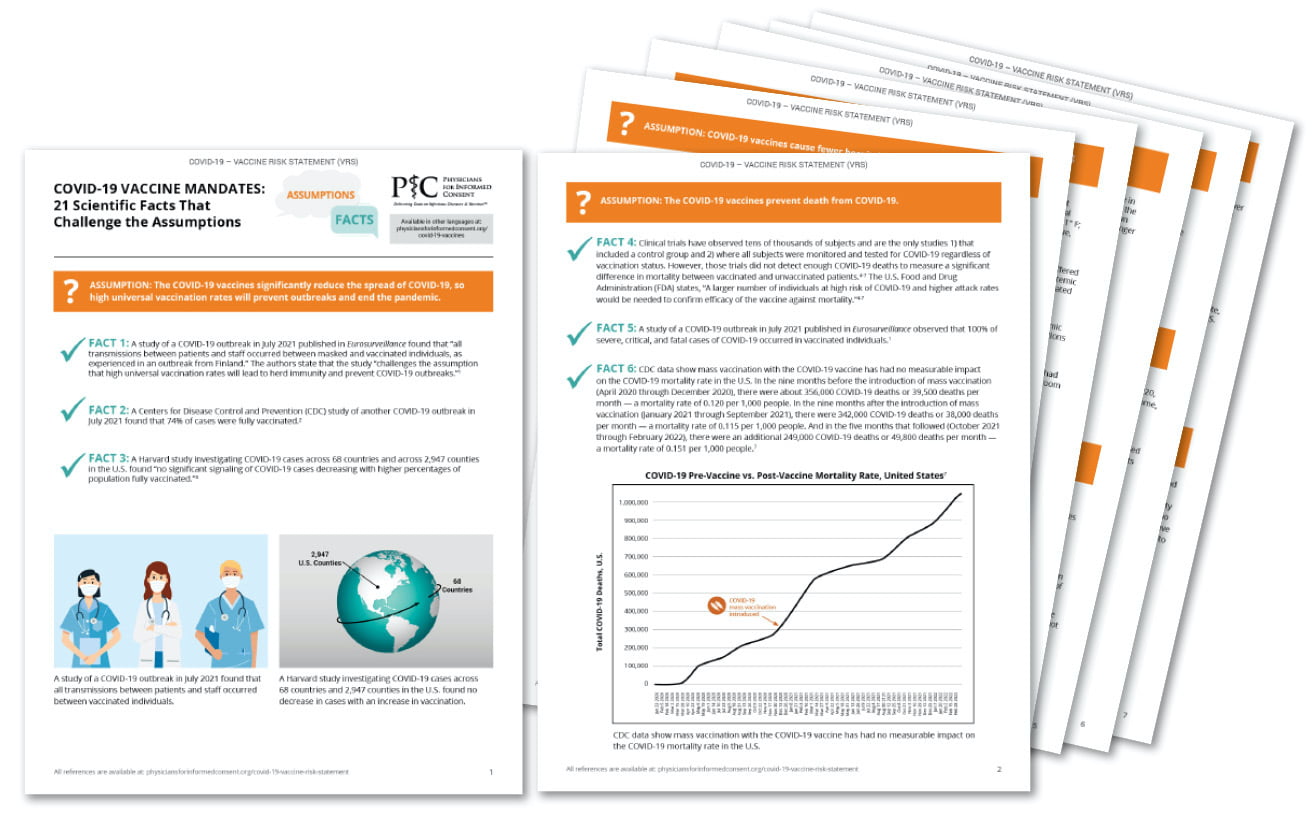
The amicus highlights a Centers for Disease Control and Prevention (CDC) report from a July 2021 outbreak in Cape Cod, Massachusetts, where 469 COVID-19 cases were identified among residents who had traveled to the town and 346 (74%) occurred in fully vaccinated persons. Of the five hospitalized cases, four were fully vaccinated. The CDC stated, “Cycle threshold values were similar among specimens from patients who were fully vaccinated and those who were not,” which means both vaccinated and unvaccinated persons can equally spread SARS-CoV-2 if infected, and there is no scientific basis for discrimination based on vaccination status. Per the CDC, “…preliminary evidence suggests that fully vaccinated people who do become infected with the Delta variant can spread the virus to others.”

FIGURE 1 Cape Cod July 2021 COVID-19 Outbreak
Figure 1. Number of Fully Vaccinated Persons with COVID-19 in Cape Cod July 2021 Outbreak

“Additional data in the amicus brief illustrates that unvaccinated persons previously infected with SARS-CoV-2 are 99.9% protected from reinfection, and approximately 180 million Americans have already been infected. Restricting people’s life, liberty, and pursuit of happiness based on vaccination status is both unscientific and unethical, and should not be possible for government-funded institutions in the United States,” said Dr. Shira Miller, PIC founder and president.

Physicians for Informed Consent’s body of physicians, scientists, statisticians, and healthcare workers is trusted by both patients and practitioners for providing scientific data on infectious diseases and vaccines. To learn more, read PIC’s amicus brief.

About Physicians for Informed Consent

Physicians for Informed Consent is a 501(c)(3) educational nonprofit organization focused on science and statistics. PIC delivers data on infectious diseases and vaccines, and unites doctors, scientists, healthcare professionals, attorneys, and families who support voluntary vaccination. In addition, the PIC Coalition for Informed Consent consists of approximately 300 U.S. and international organizations. To learn more or to become a member, please visit physiciansforinformedconsent.org.

###

VIEW the press release on PRWeb.
SHARE the press release on Facebook.
SHARE the press release on Instagram.
SHARE the press release on Twitter.
SHARE the press release on LinkedIn.

PIC Letter to Cal/OSHA: Reject Proposed Revisions of COVID-19 Prevention Emergency Temporary Standards

California Department of Industrial Relations
Occupational Safety and Health Standards Board
2520 Venture Oaks Way, Suite 350
Sacramento, CA 95833
OSHSB@dir.ca.gov

RE: Reject the proposed revisions of Cal/OSHA COVID-19 prevention requirements

Dear Board Members,

On behalf of Physicians for Informed Consent, I am writing regarding the proposed revisions of the Cal/OSHA COVID-19 prevention requirements,1 which will be considered at your June 17, 2021, board meeting. The updated guidelines aim to treat California workers differently depending on their COVID-19 vaccination status. However, key scientific data demonstrate that discrimination is unwarranted. Before you implement a new policy for the workplace, I urge you to consider the following:

1. There is no evidence that COVID-19 vaccines prevent the spread of SARS-CoV-2 or COVID-19. Therefore, there is no scientific justification to treat vaccinated people differently from unvaccinated people.

Clinical trials for the Pfizer-BioNTech, Moderna, and Janssen (Johnson & Johnson) COVID-19 vaccines were not designed to observe asymptomatic infection with SARS-CoV-2 or the effect of the vaccine on the spread (transmission) of COVID-19. Consequently, in its briefing document for each vaccine, the U.S. Food and Drug Administration (FDA) states that “it is possible that asymptomatic infections may not be prevented as effectively as symptomatic infections” and “data are limited to assess the effect of the vaccine against transmission of SARS-CoV-2 from individuals who are infected despite vaccination.” Furthermore, “additional evaluations including data from clinical trials and from vaccine use post-authorization will be needed to assess the effect of the vaccine in preventing virus shedding and transmission, in particular in individuals with asymptomatic infection.”2-7

2. There is evidence that previous SARS-CoV-2 or COVID-19 infection is more effective at preventing SARS-CoV-2 or COVID-19 infection than at least one of the COVID-19 vaccines. Therefore, those previously infected with COVID-19 should have at least the same rights as those vaccinated for COVID-19.

The Janssen (Johnson & Johnson) COVID-19 vaccine clinical trial included over 2,000 subjects that had contracted SARS-CoV-2 before the study. The trial recorded the incidence of COVID-19 in that unvaccinated group at least 28 days after the vaccination of the other subjects in the study. The COVID-19 incidence of the unvaccinated group with prior SARS-CoV-2 infection was 0.1% (2/2,021), whereas the COVID-19 incidence of vaccinated subjects was 0.59% (113/19,306). These data suggest that there are six times more cases of COVID-19 in vaccinated subjects than in unvaccinated subjects previously infected with SARS-CoV-2. This also means that an unvaccinated person previously infected with SARS-CoV-2 has 99.9% chance of being protected from a repeat infection.7,8 Of note, as of April 17, 2021, there have been 165.7 million SARS-CoV-2 infections in the U.S., which is 50.2% of the U.S. population.9

Treating people differently depending on their COVID-19 vaccination status is not based on science. As Cal/OSHA is responsible for ensuring the safe and healthful working conditions for all workers, we urge you to reject the proposed guideline revisions and instead implement a policy that ensures all employees are treated the same, regardless of their vaccination status. We are here to assist you in these highly technical matters and welcome further discussion.

Respectfully,
Shira Miller, M.D.
Founder and President
Physicians for Informed Consent


References

  1. Cal/OSHA. Standards presentation to California Occupational Safety and Health Standards Board; 2021 Jun 11. https://www.dir.ca.gov/oshsb/documents/Jun172021-COVID-19-Prevention-Emergency-txtcourtesyReadoption.pdf.
  2. U.S. Food and Drug Administration, Vaccines and Related Biological Products Advisory Committee. FDA briefing document: Pfizer-BioNTech COVID-19 vaccine. Vaccines and Related Biological Products Advisory Committee Meeting: December 10, 2020. https://www.fda.gov/media/144245/download.
  3. Physicians for Informed Consent. Pfizer-BioNTech COVID-19 vaccine: short-term efficacy and safety data. Jun 2021. https://www.physiciansforinformedconsent.org/COVID-19-vaccines.
  4. U.S. Food and Drug Administration, Vaccines and Related Biological Products Advisory Committee. FDA briefing document: Moderna COVID-19 vaccine. Vaccines and Related Biological Products Advisory Committee Meeting: December 17, 2020. https://www.fda.gov/media/144434/download.
  5. Physicians for Informed Consent. Moderna COVID-19 vaccine: short-term efficacy and safety data. Apr 2021. https://www.physiciansforinformedconsent.org/COVID-19-vaccines.
  6. U.S. Food and Drug Administration, Vaccines and Related Biological Products Advisory Committee. FDA briefing document: Janssen Ad26.COV2.S vaccine for the prevention of COVID-19. Vaccines and Related Biological Products Advisory Committee Meeting: February 26, 2021. https://www.fda.gov/media/146217/download.
  7. Physicians for Informed Consent. Janssen (Johnson & Johnson) COVID-19 Vaccine: Short-Term Efficacy & Safety Data. May 2021. https://www.physiciansforinformedconsent.org/COVID-19-vaccines.
  8. U.S. Food and Drug Administration, Vaccines and Related Biological Products Advisory Committee. FDA briefing document: Janssen Ad26.COV2.S vaccine for the prevention of COVID-19. Vaccines and Related Biological Products Advisory Committee Meeting: February 26, 2021. Table 14: vaccine efficacy of first occurrence of moderate to severe/critical COVID-19, including non-centrally confirmed cases, with onset at least 14 or at least 28 days after vaccination, by baseline SARS-CoV-2 status, per protocol set; 30. https://www.fda.gov/media/146217/download.
  9. Statistical Analysis of the Frequency SARS-CoV-2 Infections in the United States
    A Stanford University systematic review that included 69 antibody studies estimated that the COVID-19 infection fatality rate (IFR) in the United States ranges from 0.3% to 0.4%.a Data analysis herein uses the midpoint of that range, 0.35%. An IFR of 0.35% is also supported by an analysis published in Clinical Infectious Diseases that estimated that there were 44.8 million symptomatic COVID-19 illnesses in February–September 2020.b Additionally, since 33% of all SARS-CoV-2 infections are asymptomatic,c there were an estimated 66.9 million (44.8 million/[100%-33%]) total number of SARS-CoV-2 infections in that time period. There were also 213,000 COVID-19 deaths in February–September 2020,d resulting in a COVID-19 IFR of 0.32% (213,000/66.9 million). As of April 17, 2021, there have been about 580,000 COVID-19 deaths in the U.S.d As the COVID-19 IFR is about 0.35%, as of April 17, 2021 there have been about 165.7 million SARS-CoV-2 infections (580,000/0.35%), which is 50.2% of the population of the U.S. (330 million).

    a Ioannidis, JPA. The infection fatality rate of COVID-19 inferred from seroprevalence data. Bulletin of the World Health Organization. 2020 Oct 14 [cited 2021 Apr 16]. https://www.who.int/bulletin/online_first/BLT.20.265892.pdf?ua=1.
    b Reese H, Iuliano AD, Patel NN, Garg S, Kim L, Silk BJ, Hall AJ, Fry A, Reed C. Estimated incidence of coronavirus disease 2019 (COVID-19) illness and hospitalization—United States, February–September 2020. Clin Infect Dis. 2020; Nov 25;ciaa1780. https://doi.org/10.1093/cid/ciaa1780.
    c Oran DP, Topol EJ. The proportion of SARS-CoV-2 infections that are asymptomatic: a systematic review. Ann Intern Med. 2021 May;174(5):655-62. https://doi.org/10.7326/M20-6976.
    d Worldometer. Coronavirus: United States. https://www.worldometers.info/coronavirus/country/us/.

Download Letter (PDF)

Enclosed:
Pfizer Bio-NTech COVID-19 Vaccine Risk Statement
Moderna COVID-19 Vaccine Risk Statement
Janssen (J&J) COVID-19 Vaccine Risk Statement

Physicians for Informed Consent Updates Its Pfizer-BioNTech COVID-19 Vaccine Risk Statement for Healthcare Providers and Families

Educational document highlights Pfizer clinical trial finding that 1 in 9 vaccinated adolescents suffered a severe adverse event

NEWPORT BEACH, CALIF. (PRWEB) JUNE 8, 2021

Physicians for Informed Consent (PIC), an educational nonprofit organization focused on science and statistics, recently published an update of its Pfizer-BioNTech COVID-19 Vaccine Risk Statement, which includes key questions and answers about the clinical trial data. The Pfizer COVID-19 vaccine is the first COVID-19 vaccine to receive expanded emergency use authorization (EUA) for adolescents; however, the vaccine is still not FDA-approved.

The PIC Pfizer-BioNTech COVID-19 Vaccine Risk Statement (VRS) answers important questions such as:

  • How effective is the vaccine in children, adults, and the elderly?
  • Is the vaccine effective in preventing hospitalizations and deaths?
  • Is the vaccine effective and safer than the COVID-19 virus?
  • Does the vaccine prevent the spread of the virus?

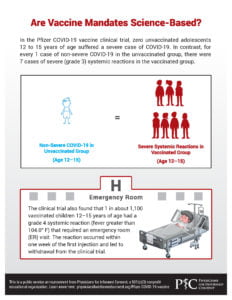
The updated document indicates that for children 12 to 15 years of age, the Pfizer COVID-19 vaccine clinical trial found the overall incidence of severe adverse events during the two-month observation period to be 10.7% or 1 in 9 in the vaccinated group. In addition, the incidence of COVID-19 in the unvaccinated group was 1.6%; therefore, there were almost seven times more severe adverse events observed in the vaccinated group than there were COVID-19 cases in the unvaccinated group.

Furthermore, since only about 1,100 vaccinated children 12 to 15 years of age were observed in the clinical trial, there were not enough children included in the trial to be able to prove the vaccine is safer than the disease in children 12 to 15 years of age. The chance of a child 0 to 17 years of age contracting SARS-CoV-2 and dying from COVID-19 is 1 in 290,000.

Anyone considering the COVID-19 vaccine must be informed of known and potential benefits and risks, and the extent to which benefits and risks are unknown. For example, the clinical trial did not have enough statistical power to measure the vaccine’s ability to prevent hospitalizations and deaths, and did not assess if the vaccine prevents asymptomatic infection or spread (transmission) of the virus.

“PIC is committed to making the available data more accessible to everyone researching COVID-19 vaccines,” said Dr. Shira Miller, PIC founder and president. “Our concise, reader-friendly document assists healthcare providers and parents in making informed decisions for the children in their care.”

Physicians for Informed Consent’s body of physicians, scientists, statisticians and healthcare workers is trusted by both patients and practitioners for providing scientific data on infectious diseases and vaccines. To download your copy of the VRS “Pfizer-BioNTech COVID-19 Vaccine: Short-Term Efficacy & Safety Data,” visit physiciansforinformedconsent.org/COVID-19-vaccines.

###

VIEW the press release on PRWeb.


About Physicians for Informed Consent
Physicians for Informed Consent is a 501(c)(3) educational nonprofit organization focused on science and statistics. PIC delivers data on infectious diseases and vaccines, and unites doctors, scientists, healthcare professionals, attorneys, and families who support voluntary vaccination. In addition, the PIC Coalition for Informed Consent consists of more than 250 U.S. and international organizations. To learn more or to become a member, please visit physiciansforinformedconsent.org.